

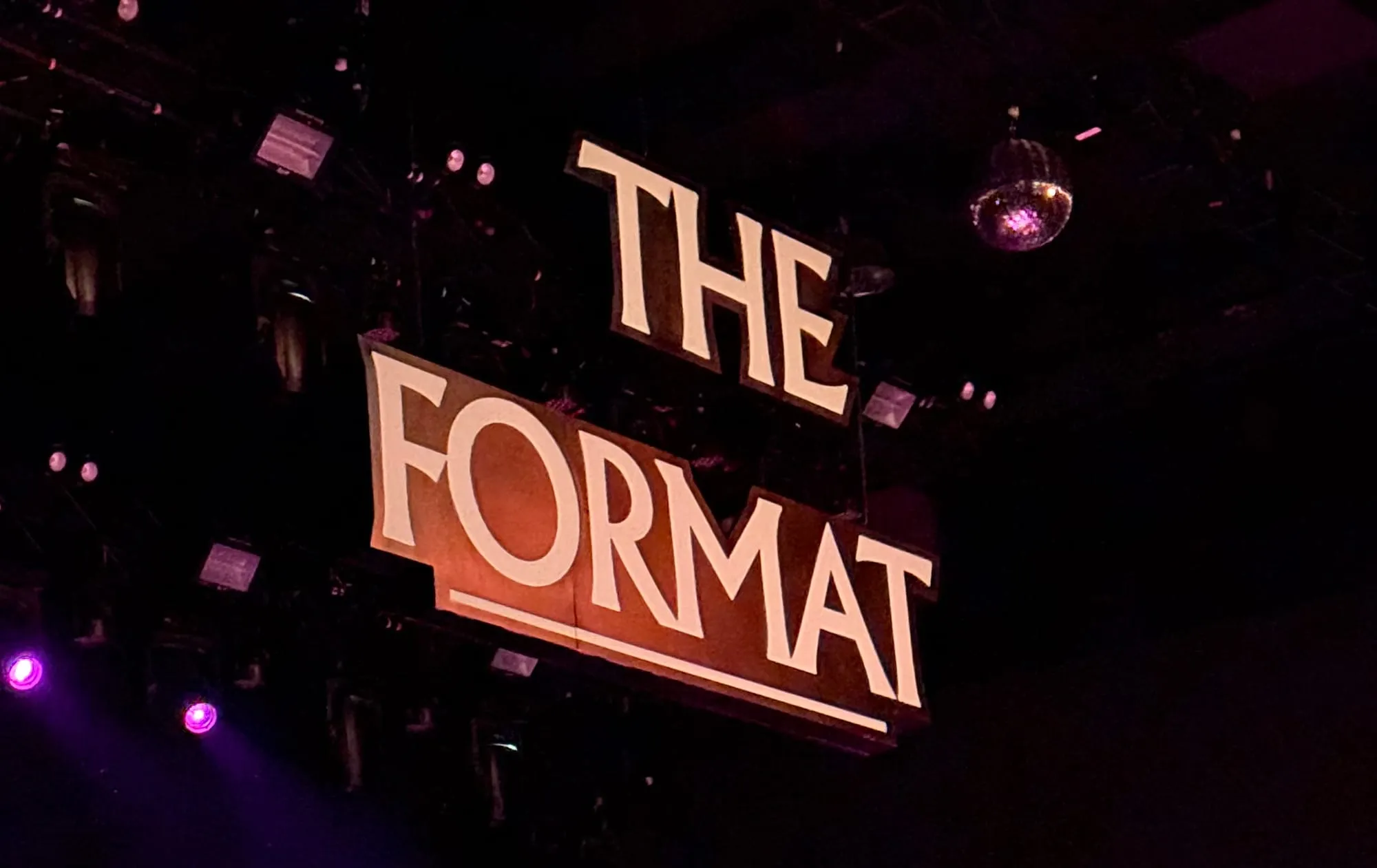
Indie pop concerts in Boston aren’t in short supply! However, the stage carries special significance and nostalgia for The Format, led by Nate Ruess and Sam Means, who haven’t performed as a duo since 2007.
Their newest album, Boycott Heaven, released in January 2026, marks a return fueled by community, emotion, and a hope for a better world. With a similar teenage garage band punk-rock sound of their youth, Boycott Heaven takes us back to the early 2000s. Sam and Nate appear to fall back into musical creation and performance together, as if they never left. On March 26, 2026, I was lucky to be able to sit down with Sam Means on the first night of the Boycott Heaven Spring 2026 Tour in Boston.
Thank you so much again for your time. I really appreciate it. I'm sure you're very stressed and busy right now.
Sam: Absolutely, no, it's good to have something to take my mind off this, actually.
Okay, good, I'm glad. So, tonight is like the first night of the tour, right? I guess I just wanted to see how you're feeling: what are you looking forward to the most? What are you excited about? Things like that.
S: Very excited to do this tour — this is the first tour that I've done since 2007. So I'm really anxious about doing it. I said nervous when I was talking to some of the guys in the band, and I'm not actually nervous. I'm just anxious. But yeah, it's exciting. We really have been looking forward to this. We've done a handful of shows kind of scattered, but this is the first proper tour. And yeah, we’ll see a lot of friends and family and then play music for some of the coolest fans ever that have just hung around for the last 20 years. It's gonna be a good time.
I was really struck by the coupling with community organizing that you guys have throughout your tour. I was wondering if you could speak a bit more about what led you to incorporate that into your plans?
S: Yeah, I don't know if it was super planned. Like, I can't speak too much on the lyrics because I didn't write them. But if you listen to the album, there's definitely some really important stuff in there. When I was younger, and Nate was younger, we were really into a lot of punk bands, and a lot of those bands were talking about stuff that we didn't understand, just being kids from the suburbs. But over the course of your life, you start to connect the dots. You're like, “Oh, I heard somebody singing about that when I was 16,” singing about Food Not Bombs or something. Then being exposed to them later in life and then realizing, “Wow, this is really important work, and these people have been doing this for a really, really long time.” Going back and listening to some of those songs, even from that era, and just realizing that — it's kind of depressing, but a lot of things haven't changed. In a lot of ways, it's worse. In some ways it's better, but in a lot of ways it's worse, you know? That's something that we were coming to terms with as older dudes with the ability to maybe try to experiment in some ways that we couldn't have done when we were younger, because we're not doing this version of the format as a career. We're just doing it because we want to. It's really exciting for us. It's fun. We're having a blast. It's something that we really want to be doing.
The world's always kind of a crazy place, but in the last five, six years in particular, it really feels like it's been ramping up. Horrible things are just becoming normal, you know? Since it is so easy to get desensitized to some of these things, as I've gotten older, I've been wanting to actually learn about them. Why is this becoming so normal, and I’m not paying enough attention to it? I feel like that's really a dangerous thing to do. I think it was really weighing on Nate and me to want to do more. We just came to the realization that right now, especially, it's very important to take more action in a public way. We were thinking back to when we were teenagers and to things we read about from the 60s and 70s, and kids in colleges just getting out and yelling and being loud about things. So we just thought, hey, maybe we can create a space where we can play music for people, but then maybe in addition to that, we can invite some people locally to come and speak about what's important to them, what's happening in the community. And maybe that will be a cool bridge to get people who might otherwise be nervous or feel like they don't belong at a political rally or a protest or something. Maybe those same types of people could speak to regular people if they're just at shows in a more welcoming way.
So we did one here last weekend on Saturday, we did this thing called the Saturday in the Park, which we just sort of came up with about six weeks ago. It went really well. And we're going to keep doing them every Saturday on this tour. We're hoping maybe this will inspire other bands to do similar things because it's really easy to just go out and park and play some music, and get some people together. We got a lot of good feedback from all the people we invited to speak. But it's also really cool that we're able to do that in a way that we don't necessarily have to keep them separate from the concert. We think it's cool to do it that way because we can do both. You can come to the show and have fun, and in the afternoon, maybe learn some stuff, walk away with something that might be valuable and might shape the course of your life if you're a younger person, like a lot of these things did for us when we were younger.
What was the process of reconnecting with Nate, creating this album, the style of it — what were you thinking about?
S: We're friends, and we stayed friends throughout this very extended hiatus that we were on. In 2020, right before COVID and all that stuff, we had gotten together, and we had been talking about it for years, but it finally just worked out with everyone's schedule. And at the time I mentioned, like, “hey, it'd be fun to make some music too.” Nate, at that time, was very, very, very tired from making music and just liked the idea of playing some shows a little bit more. So we agreed to do that. But then that fell apart. A lot of people were stuck at home, and Nate decided to pick up the guitar and start learning how to play guitar, which reinvigorated his desire to write. So he started writing some songs, kind of inspired by holding this thing that he had never really held before, and doing so as a very seasoned songwriter too, which is really cool, you know? So I went to visit him a couple years ago, and he was like, “Hey, come down and check out these songs I've been working on.” So I heard it, and maybe heard four or five songs that weekend I was over there. And I was like, “This stuff's really great. What are you gonna do with it, put it out?” And he said no. And then, you know, fast forward a year later, he called me, and he's like, “Hey, actually, I think I do want to put out some music. What do you think about taking some of these songs and then writing a few more?”And the songs were in various forms of being done; a lot of them didn't have bridges, so he wanted me to come in and really kind of help get those ones over the hump. We started swapping back and forth. I'd go out to California, he’d come to Arizona. Every couple of weeks, we would do that. We did that for a few months. And then ended up working with this guy, Brendan O'Brien, who's a very awesome producer. In the 90s, he recorded like every cool alternative album, you know, that we were listening to. So we met up with him in January of last year. and spent a few months just knocking it out. And here we are. But I would say the real inspiration was just the guitar, Nate learning that again, and us kind of going back to where we started. This is our main band together that we've had, but we were in two bands before this that were much heavier, electric guitar-focused bands, like pop punk bands, almost. We're kind of returning a little bit to our musical roots from when we met each other. And just having a lot of fun doing it.
That's wonderful! I know you mentioned earlier that you don't write the lyrics. Are you content with that role, or do you ever see yourself being more of a songwriter?
S: Yeah, I'm very content with that role. I did accidentally write some lyrics for this album, one of the times when Nate was out in Phoenix. He was like, “Hey, we really need to start on this bridge.” And while he was at his hotel, I went back home to go take a walk, and when I was walking, I came up with this idea. And so I came back, and I played the guitar part. And then I had a vocal in my head that I was just singing along. And he's like, “This actually isn't a bridge. This is a new song. This should just be a different song. It's a good part.” About an hour later, we met back up, and he had the rest of the song written. And that song ended up being the song “Boycott Heaven.” But other than that, I mean, Nate's such an insanely brilliant lyricist. I think he always has been, but he's obviously even more so now.
How would you say being on your own for a little bit and maturing has influenced your music from your earlier iterations?
S: Yeah, I think I know how to speak for both of us, which I think we have just learned a lot as people. We met when we were 16, and we started playing in bands together maybe a year later. And did that until our mid to late 20s, it just was nonstop. And at that time, really motivated by “this is what I want to do with my life.” There's just a drive there that is different than what we have now. And also sometimes you just need a break from people, especially in creative partnerships. Those things can run their course at a certain point, but that doesn't mean they're over forever. It was always important to us that whenever we were to do this again, it would be for the right reasons. So the process of writing, I mean, it was like riding a bike because there's more time in between not being a band than there was when we actually were a band. But the years that we were a band were very formative for us as people. So you create this bond, sort of like a shorthand, spiritual connection, something there that's hard to explain. That's just there, that's just kind of there forever. And that made it really easy to jump back in. But then, just as people, I think we've grown. We're both dads. We have kids. So we've certainly both learned a lot about patience and communication, choosing battles, and what's a healthy conversation to have. You know, those types of things. So we're getting along very well. We always have, but like just kind of extra well, you know, 'cause we're just too tired to worry about anything else except for what's on the horizon.
My last real question is a fun one: what's your favorite song on the album?
S: Right now it's “Boycott Heaven.” That's been my most fun one to play. I've been singing that one sometimes, too, in the beginning, that first verse and chorus. That's another thing I never really did to sing much, but I've been practicing a lot here with this stuff now. But I really like playing that one. I think it really encapsulates the spirit of the album in a lot of ways, not just because it's called Boycott Heaven, but I think that's why it is called Boycott Heaven as a song. The stuff that he went back in that hotel room and wrote, and these other parts that all just fit together in this very big anthemic way. So I think that one's been one of my favorite songs to listen to on the album. But also, it's just really fun to play, because it's loud. And it's great.
Hailey Akey '27 is a staff writer for WHRB.