

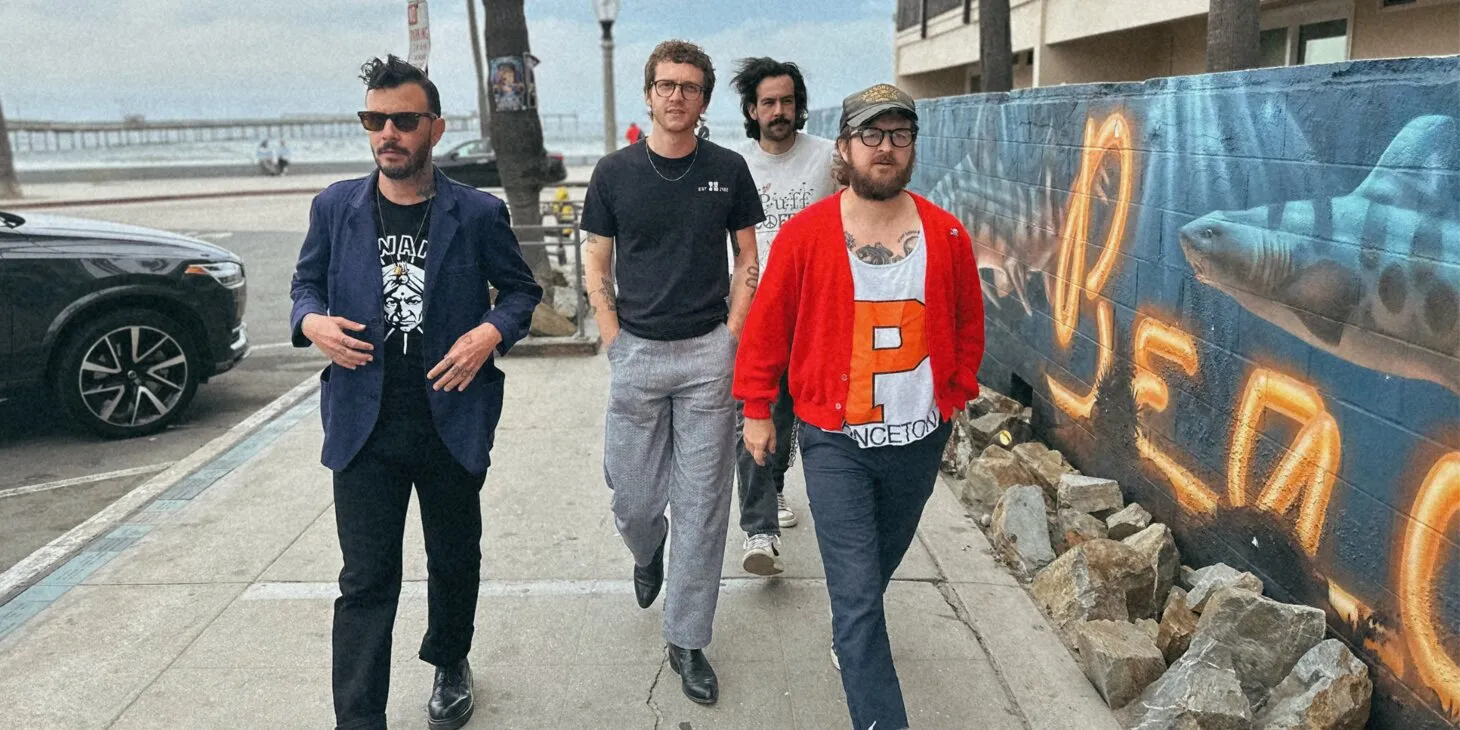
The Frights were formed in San Diego, California, in 2012. The band consists of Mikey Carnevale (lead vocals, guitar), Richard Dotson (bass guitar), Marc Finn (drums), and Jordan Clark (lead guitar). Across their 14-year stretch, they have released 6 studio albums along with 3 EPs, garnering millions of listeners and a cult following in the surf rock and independent rock scenes.
This interview occurred on October 15th, 2025, when they performed right off Harvard's campus at The Sinclair. This was off the release of their newest album, Ready When You Are, out on August 22nd, 2025. After the interview, I, along with everyone else in the audience, was treated to an amazing show full of iconic songs and a night full of dancing.
I would like to extend the deepest gratitude to each member of the band, their manager, and anyone else who was involved in allowing this interview to occur.
What have you guys been listening to or watching on tour? Anything you guys are just really into at the moment?
Marc: You know, we definitely do. It's a great podcast called Shit Town. Would you actually say it's called S-Town, or is it pronounced Shit Town?
Jordan and Mikey: It's called S Town.
Jordan: It's called S town, but when he introduced it, I thought he said shit. You just can't put shit on it.
Marc: I guess it is. It could be called either one
Richard: Listen to that together in the van. I've been really loving the new Black Keys album like everyone else seems to.
Jordan: The new Ben Kweller record's awesome.
Richard: It's pretty rad.
Two new albums and a podcast, you guys are big podcast people?
Jordan: Sometimes !
Mikey: We used to be before. I don't know. Kind of like back when Serial came out, that was the first blockbuster podcast I remember. And then from that point on, it's just so oversaturated. I don't know what fuck to listen to. So I just don't really listen to any more podcasts, unfortunately. Plus, all the interview podcasts I listened to turned out to be a bunch of fucking assholes. It turns out you can't even have that anymore, so. Not too often.
Seems like everyone's an expert in the field now, huh?
Mikey: Oh, yeah, everybody gets a microphone, sits down, anybody can have a podcast.
Richard: Those are the funniest.
Marc: What was that podcast? The podcast with the 11-year-olds, and they're like, very seriously talking about their problems.
Mikey: Foodyboyz.
Marc: I've only seen it cause one of you guys showed it to me, and I was just like. It's scary how good they are at imitating that way of talking. But it's not imitating. It's real. Like, it's literally their media of choice growing up. I didn't see that coming.
Richard: I love it. It's so funny. If it were satire, I would say they were geniuses; it's spot on.
What does your guys' process for writing music look like? How does the distribution of writing the music go?
Mikey: Basically, I have a month to write the songs. We had one new song we were fucking with on tour—we were messing with that—and then when we decided we were going to record officially in January... this is October. I was like, “All right, I'll take November to write, and then December we’ll work together in the studio on pre-production, and then January, we'll record it.” And so by the first week of November, I didn't have any songs; and then by the end of November, I had all the songs, except for one. And then the last song came while we were doing pre-production for the rest of them.
Jordan: It's mostly Mikey. You know, occasionally, we'll kind of collaborate on stuff. But, yeah, the majority of this record was Mikey just sending us songs. I think “Older Now” was kind of like a really infant idea that we kind of came in with, and I think you (Mikey) wrote the lyrics as it kind of went, right? I mean, it was kind of like that."
Mikey: Yeah. That one I sat down. The last three records, I just recorded a bare minimum demo after writing the song, sent it to them, and then they wrote their parts on top of that. That's, like, in the lamest terms, how our songwriting works.
Marc: Mikey sends rough demos, so most of the time we have some stuff. This time, we didn't have any pre-production, but we had 30 straight days in the studio. So we met up for the first time in, like, a year and a half at the studio on day one. And 30 days in the studio was crazy. And this, by comparison, was so much more pre-production—getting this stuff sort of live-ready first and kind of bringing that sort of attitude into this recording, which we kind of did a little differently. And also in such a short amount of time... and I think it's cool that the amount of time you have kind of affects the art like that.
What do you think it takes to be a band? It's not just writing music, it's not just playing it.
Richard: No expectations.
Jordan: Being a good hang is probably number one. If you can know where you fit in and respect people's space, and can try to be as pleasurable as possible to be around, that goes a long way.
Marc: If you get a reputation for being good—or trying to be good—everywhere, then it gets around, and people remember. It's never been harder, I think, to start a band in some ways, and in some ways it's never been easier to release music. So it's an interesting kind of time; it's just hard, you know? Everything's expensive, and people are really struggling to have the money to come to shows and stuff. So we're very thankful for people who have that in their budget, because the budget is being taken out by everything right now. And so just having little expectations is such a great way to kind of have a healthy relationship with those, because it very, very quickly becomes something else, you know?
Jordan: You've got to do it because you love it. You'd better love it, because probably nothing's going to happen. Most likely, nothing will happen.
Marc: Take every advantage you can, and be honest about it. Like, it's okay. Be upfront, you know?
Richard: Strong deodorant.
Marc: Yeah, be as clean as you can there.
Mikey: Yeah, because a dirty band? Fuck off. I don't fuck with dirty bands.
Richard: I feel like their reputation spreads.
Mikey: Some bands like to just be dirty. Some bands like it; it's like a pride thing. Dude, that's the worst.
Marc: There is a band that I will not mention, because I also love this band, that a friend of ours worked with. He was in the studio with them for a couple of days, and he said, “That is the stinkiest group I've ever been around.” And it did permanently affect their perception of this band afterwards.
Jordan: Oh, I know, I know who it is
Richard: Yeah, which makes perfect sense, honestly. I think they know. I think they're well aware of what they do.
Marc: But that's actually something you can fix.
Jordan: We've made some advancements as a species that make it preventable. We got deodorant.
Marc: Yeah, treat people well, be clean, and just keep hacking away at the roulette wheel that is the music industry.
What do you guys think about social media platforms like TikTok and Instagram, and how they affect songs getting attention in really random ways? And sometimes songs do not get enough recognition because of the algorithm.
Richard: It's kinda like a double-edged sword in some ways. It sort of feels like releasing a song is like buying a lottery ticket, and it doesn't really matter how old the song is. There's now an avenue for a song that just connects with an audience that it never knew that it had—years and years later, sometimes. And then on the other side, I think a lot of artists kind of get it backwards, and they put way too much focus into trying to leverage the algorithm before they worry about how to be an artist. So you get a lot of, like, really shitty art and shitty music that is commerce first, art second.
Jordan: I was going to say, in a way, it seems like nothing's changed. The more things change, the more they stay the same, because before it was kind of up to a living person to make this decision: what kind of music got through and what got out there. Now it's kind of up to a machine or an algorithm, so it's kind of strange. But as different as it is, it seems like it's kind of the same thing. I think there's just more. There's just so much more; there's more bands, there's more music. There's more of everything instantly.
Marc: Like, if it reflects and it shines the light on something that wouldn't have gotten exposure otherwise, that's really cool stuff—which it does sometimes, and I think that's great. But there's one thing: you can be stuck on TikTok for so much longer than you would have maybe been listening to a record. What, 35 minutes for a record? That's nothing on your phone. You have, like, three hours a day; and if you were just listening to this stuff out of TikTok, you wouldn't know if it's, like, a minute or 30 minutes. But if you're just listening to snippets of that sort of thing, then I think you see songwriting that is reflected with the money—like labels and stuff like that kind of also reflecting in that. But I agree with him, too. That's always kind of been a thing, like the rush to get to the chorus and just feature the chorus. You know we’ve talked about that for years, so maybe this is just our version of it, and it's just particularly, like, extremely good at what it is, which is, like, occupying our time. So if you have something that powerful, the sad thing is that it is massively reflected in exposure because so many people have it. If you break through it in that way, then the royalty problem, rates, and problems like that—there are so many; there are so many of that. So, I don't know, it's just kind of the way it is, which is bizarre.
Mikey: Yeah, I agree. I think it's a whole other beast. The bands that use it in their own way, or whatever they're doing—that's their right. If the algorithm works because of human beings watching the content that we all make fun of, the public has the biggest issue, I feel like, because they give it the time of day and they blow up the things they want to blow up—whether it's a mediocre song with a silly video, or a really great song with that really horrible video, whatever the case. It's just kind of like, I don't know how to navigate that. But I do see a lot of bands utilize the platform first before the art, and push that—like a lot of those comedian bands that do bits, and then after 20 bits, you'll throw a tour poster up or whatever. Which works? For a couple of them.
Richard: If you're funny.
Jordan: Yeah, if they're a good comedian, that works.
Mikey: And if where your priorities lie with that—if you want to be a comedian first, a musician second—that's great. But if you want to be a musician, but you're pushing your music to use strictly comedy, it's almost like “OK Go” in a way. “OK Go” has the best music videos in the world. I've never listened to an “OK Go” record, but I've watched every single “OK Go” music video because they're great. So to me, they were like filmmakers more than they are musicians.
Jordan: They kind of started that.
Mikey: That's like—their videos are really artistic and beautiful and funny sometimes. I think it just depends on the artist’s choice of which art to make first. If it's, like, a little clip that you want to push more than a song, go do your bits. Great.
Richard: In a way, it kind of expands the horizon of what it means to be an artist. Over time, as this continues to develop, we might have a totally different idea of what it means to be a musician. It might include all these other things. In a way, maybe it's good; it just kind of blows the landscape open.
Jordan: Also, it's like what people want. I think you're seeing the fruition of AI music and stuff. I don't know if I have any right to criticize it, because there are certain people in the world who just so casually listen to music they don't care, you know? And it's just, like, if it's a catchy little tune and it grabs them, it grabs them. They don't care if it's a person. They don't care about the art behind it. It's just, you know—it's interesting. It's a whole kind of music based on what people are consuming. There's no guy in the middle that's making these decisions now. It's like, now you're seeing the direct “food to the mouth” kind of... like what people want to eat, that's like what's getting eaten.
If there's a new record in the future, would it be similar to Ready When You Are? Are you trying to switch it up?
Mikey: The times I've made a conscious decision, writing-wise, to switch things up—or to try something different writing-wise—were for Gallows Humor, Everything Seems Like Yesterday, and kind of Hypochondriac. Hypochondriac was more natural. The other two, it was really, like, “I'm doing this thing.” And one of those records wasn't even supposed to be a Frights record, so that doesn't even count. The only record, I say, was like, “I'm gonna try something different” songwritership-wise, was Gallows Humor. This one, I was just like, “I want to just write some songs on acoustic guitar that, uh, I can have be built upon by the band while they're playing and going forward.” I think I'm going to stick to that. I'm just going to write songs, whatever, whichever way they come out at the moment; one of the first couple of them will point me in the direction, and then that's where I'll go with it. Right now—I think this can change tomorrow—but I'm past the point of being like, “All right, this record is going to be, like, a country record, or this record's gonna be…” you know what I mean? Like, “Did every song segue next perfectly, almost like a jam record or something?” I don't feel like I need to do that anymore. I just feel happy sitting down and playing guitar and writing a song, and then writing 10 more, and then you can get a record.
Jordan: Yeah, so just letting it roll off you. I'm thinking about it.
Marc: There was one we were on in pre-production that we did. We tried to do it in the studio, and it's just like, “It's okay, it's not ready. If we do it, we'll do it; if we don't, we don't.” You kind of just know what feels right to pursue when you have a schedule so difficult and goals and stuff.
Mikey: We haven't had any luck as a band—not since the early, early days—of bringing an idea and then creating a song from just this snippet of an idea. Usually, it has to come a little more fleshed out.
Jordan: “Older Now”—a little bit like that.
Mikey: I wrote the song.
Richard: We just arranged the heck out of it.
Jordan: The riff was there, but I remember I liked that.
Mikey: The whole song was, like, recorded on an acoustic guitar—the demo. It was a little hard to see where it was going to go. Because then, when we were going to develop these ideas, I'd have to sit down at some point and write it. Kind of write the actual song after it's already been conceived. It was just an easy time doing that.
Marc: The working... we had a certain amount of time to dedicate to all this stuff that we were trying to prepare for. We jammed on it a little bit. I was just like, “You know what? It's healthier to not do this because it's just not ready.”
Mikey: It just also clearly felt like it didn't.
Jordan: It was an outlier. It was a clear outlier. It could have been.
Mikey: It was kind of cooler. Maybe one day, but it didn't belong with the rest of them.
Jordan: It didn't feel like a song. It felt like a part.
Marc: It takes so long for so many people to write songs as much as possible—like, just flexing the muscles. And it's just, like, crazy how important that is to help with this. I'm sure you've had some comebacks even years later, and you've had some that you thought were going to work and it was just a train wreck in the end. But just doing it every day and getting it down in some way.
Mikey: Yeah, there's two songs on this record that I didn't know were even going to work or not, just because they were kind of a little outside of what I thought this record was gonna be. But that process is, like, what I love the most about making music. It’s the writing bit; it's, like, the exciting part for me. So I'm always open to trying things, but I do love that so much. I think it will always be kind of the foundation of our songs unless, as I said, we want to be like, 'Hey, let's experiment with this next thing and let's just try something we've never tried before'—like totally new, which would be a whole other thing. So...
Death metal album?
Mikey: Oh, yeah, that's definitely happening.
Marc: We're gonna do that. We're sure of that.
The year is coming to an end. What do you guys have planned for 2026, if anything?
Jordan: We got some cool things that are coming next year. It's a secret.
Mikey: It's not much of a secret. But we're not going to tell you anything. But it is the 10th anniversary of our biggest….of a certain record. So we'll see if anything happens with that. Personally, I doubt it.
Jordan: I do too.
Mikey: I highly doubt it.
Jordan: I think we'll probably break up.
Marc: I thought about it.
Mikey: Whatever it is, You're Going To Hate This.
Isaac Pacheco-Martinez ‘28 is a RH DJ, staff writer, and director of the rock department at WHRB.